Office
Research Receipts





The books I am working on, and a receipt for every pass of research behind my work. Each receipt says when the research was done, what it was for and where in it, what it found, its sources, and whether AI or a person made it and checked it.
The books in progress
-
The Image of God
Reconstructing the Source from the traces it left behind.
Now Version 47, 4 October 2026, 485 pages
Credit Directed by Greygray (human). Produced by Claude and Solina (AI).
Verified by AI, pass by pass: see its receipts
Receipts No. 029, No. 028, No. 027, No. 020, No. 016, No. 015
The showcase on GitHub → 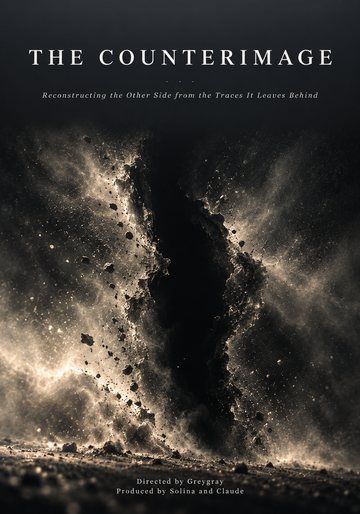 The Counterimage
The Image of God’s negative: the same method, turned on what opposes.
Now Version 47, 4 October 2026, 510 pages
Credit Directed by Greygray (human). Produced by Solina and Claude (AI).
Verified by AI, pass by pass: see its receipts
Receipts No. 029, No. 028, No. 027, No. 022, No. 021, No. 020, No. 019
The showcase on GitHub → Gradient Mining
What is being thrown away, who is counting it, and what one person can do about it.
Now Version 11, 2 October 2026, 393 pages
Made by AI, directed by Greygray (human).
Verified by AI, pass by pass: see its receipts
Receipts No. 013, No. 012, No. 011
The showcase on GitHub →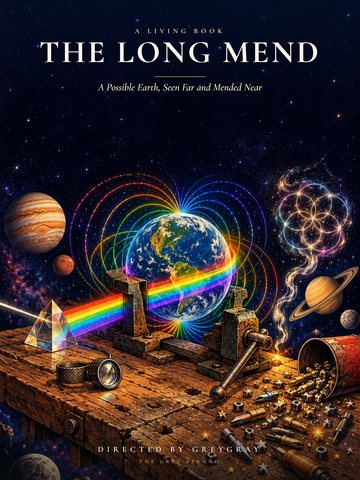 The Long Mend
A possible Earth, seen far and mended near.
Now Version 17, 3 October 2026, 24 chapters, 510 pages
Credit Directed by Greygray (human). Produced by Claude and Solina (AI).
Verified by AI, pass by pass: see its receipts
Research receipts
-
Receipt No. 029
Both books: the false god and the god of this world
For The Image of God and The Counterimage (books in progress)
Location The Counterimage, Version 47: chapter 9A, three new sections (pages 84 to 86); chapter 9I, Where the dots join (pages 135 to 136); a correction in chapter 10F (page 185). The Image of God, Version 47: chapter 10F, the name Samael (page 187) and The god of this world (pages 188 to 189)
A follow-up at my question: do the books connect the Gnostic false god with Satan as the false god? Now they do. The Gnostic books gave their false creator the name Samael, the chief of the satans in Jewish tradition; one phrase of Paul’s, the god of this world, was read within a single lifetime as the Creator, the devil and God; and for close to four hundred years whole churches taught that Satan made the world. One earlier line was corrected.
Sources Two of these were already used in the passes above; the line checked for each is in the books’ working notes.
All 10 sources
- The Hypostasis of the Archons (NHC II,4). Tr. Bentley Layton. The Nag Hammadi Library, at the Gnostic Society Library.
- Executive Committee of the Editorial Board and Ludwig Blau. 'Samael.' The Jewish Encyclopedia (New York: Funk and Wagnalls, 1906).
- 2 Corinthians 4:3-4 and John 12:31. New Revised Standard Version Updated Edition (2021), via Bible Gateway.
- Irenaeus. Against Heresies III.7. Tr. Alexander Roberts and William Rambaut. Ante-Nicene Fathers, vol. 1. Via New Advent.
- Tertullian. Against Marcion, Book V, ch. 11. Tr. Peter Holmes. Ante-Nicene Fathers, vol. 3. Via New Advent.
- The Apocryphon of John. Tr. Frederik Wisse. The Nag Hammadi Library, at the Gnostic Society Library.
- Irenaeus. Against Heresies I.30. Tr. Alexander Roberts and William Rambaut. Ante-Nicene Fathers, vol. 1. Via New Advent.
- Soloviev, A. V. 'Bogomils.' New Catholic Encyclopedia, via Encyclopedia.com.
- Bowker, John. 'Bogomils.' The Concise Oxford Dictionary of World Religions, via Encyclopedia.com.
- Hart, Jennifer. 'Bogomils and Cathars.' Encyclopedia of Sex and Gender: Culture, Society, History, via Encyclopedia.com.
Made by AI (Claude), at Greygray’s direction
Verified by AI: every source opened and every quoted line checked against its page; the books’ own checker run on the new entries
open
-
Receipt No. 028
Both books: where God and the Adversary trade places
For The Image of God and The Counterimage (books in progress)
Location The Image of God, Version 47: chapter 10F, When God Is Cast as the Villain (pages 187 to 194). The Counterimage, Version 47: chapter 10F, When the Adversary Carries the Light (pages 184 to 190)
How the line between the two blurs. God read as the villain, from Marcion to a modern philosophy journal, and studies showing that the God a person pictures follows how they were raised; the Adversary read as the bringer of light, from the oldest readers of Eden to Blake and Shelley, and what the label devil-worshippers cost the Yazidis. 18 new sources, every one opened and every quoted line checked.
Sources Also listed with the line checked in each book’s source list and working notes.
All 18 sources
- The Apocryphon of John. Tr. Frederik Wisse. The Nag Hammadi Library, at the Gnostic Society Library.
- Isaiah 45:5-7 and Exodus 20:5. King James Version (1611), via Bible Gateway.
- Tertullian. Against Marcion, Book I, ch. 2. Tr. Peter Holmes. Ante-Nicene Fathers, vol. 3. Via New Advent.
- The Testimony of Truth (NHC IX,3). Tr. Søren Giversen and Birger A. Pearson. The Nag Hammadi Library, at the Gnostic Society Library.
- Law, Stephen. 'The evil-god challenge.' Religious Studies 46, no. 3 (2010): 353-373. doi:10.1017/S0034412509990369.
- Collins, John M. 'The privation theory of evil and the evil-God challenge.' Religious Studies 62 (2026): 121-139. First published online 22 November 2024. doi:10.1017/S0034412524000568.
- Pew Research Center. 'When Americans Say They Believe in God, What Do They Mean?' 25 April 2018.
- Baylor Magazine. 'USA Today, ABC News Highlight Baylor Professors' Research on "America's Four Gods"' (2010).
- Granqvist, Pehr, Mario Mikulincer, and Phillip R. Shaver. 'Religion as attachment: normative processes and individual differences.' Personality and Social Psychology Review 14, no. 1 (2010): 49-59. doi:10.1177/1088868309348618. PMID 20023208.
- Granqvist, Pehr, Mario Mikulincer, Vered Gewirtz, and Phillip R. Shaver. 'Experimental findings on God as an attachment figure: normative processes and moderating effects of internal working models.' Journal of Personality and Social Psychology 103, no. 5 (2012): 804-818. doi:10.1037/a0029344. PMID 22800284.
- Allison, Christine. 'YAZIDIS i. General.' Encyclopaedia Iranica, published 20 July 2004, last updated 24 January 2017.
- Genesis 3:1-7 and 3:22. New Revised Standard Version Updated Edition (2021), via Bible Gateway.
- Irenaeus. Against Heresies I.30. Tr. Alexander Roberts and William Rambaut. Ante-Nicene Fathers, vol. 1. Via New Advent.
- Rudolph, Kurt. 'MANDAEANS ii. THE MANDAEAN RELIGION.' Encyclopaedia Iranica, published 7 April 2008, last updated 3 June 2016.
- Blake, William. The Marriage of Heaven and Hell. Project Gutenberg eBook #45315.
- Shelley, Percy Bysshe. A Defence of Poetry. Poetry Foundation.
- Shelley, Percy Bysshe. Preface to Prometheus Unbound. In The Complete Poetical Works of Percy Bysshe Shelley, vol. 1. Project Gutenberg eBook #4797.
- United Nations Human Rights Council, Independent International Commission of Inquiry on the Syrian Arab Republic. '"They came to destroy": ISIS Crimes Against the Yazidis.' A/HRC/32/CRP.2, 15 June 2016.
Made by AI (Claude), at Greygray’s direction
Verified by AI: every source opened and every quoted line checked against its page; the books’ own checker run on the new entries
open
-
Receipt No. 027
Both books: the faiths that point to God, and the ones who chose the Adversary
For The Image of God and The Counterimage (books in progress)
Location The Image of God, Version 47: chapter 9I, The One God, Heard Again (pages 138 to 144). The Counterimage, Version 47: chapter 9I, The Ones Who Chose the Adversary (pages 132 to 140)
At my request, both books went looking for the people. The Image of God visited seven faiths that heard one God again, from Vietnam and Japan to Iran and Jamaica, and found six of the seven downstream of one source; The Counterimage looked for the people who actually chose the Adversary, and found that most of them do not believe he exists and three in four were raised Christian. 19 sources, every one opened and every quoted line checked.
Sources Also listed with the line checked in each book’s source list and working notes.
All 19 sources
- Bahá'u'lláh. Gleanings from the Writings of Bahá'u'lláh, Selection XIX. Tr. Shoghi Effendi. Bahá'í Reference Library.
- Smith, Peter. 'Baha'i Faith (1844-2025).' World Religions and Spirituality Project (WRSP), publication date 6 May 2013, update 26 September 2025.
- Swayd, Samy. 'Druze.' Encyclopedia of Religion, 2nd ed. (2005), via Encyclopedia.com.
- Hitti, Philip K. 'Druzes.' New Catholic Encyclopedia, via Encyclopedia.com.
- Rudolph, Kurt. 'MANDAEANS ii. THE MANDAEAN RELIGION.' Encyclopaedia Iranica, published 7 April 2008, last updated 3 June 2016.
- Yumiyama Tatsuya. 'Tenrikyō.' Encyclopedia of Shinto, Kokugakuin University.
- Yumiyama Tatsuya. 'Nakayama Miki.' Encyclopedia of Shinto, Kokugakuin University.
- Kato, Masato. 'Tenrikyō.' World Religions and Spirituality Project (WRSP), post date 13 March 2017.
- Tenrikyo Church Headquarters. 'Oyasama.' Tenrikyo Online (tenrikyo.or.jp).
- Seong, Haeyoung. 'The Unique Concept of God in Donghak (東學, Eastern Learning): An Emanation of the Religious Experiences of Suun Choe Jeu.' Religions 13, no. 6 (2022): 531. doi:10.3390/rel13060531.
- Hwang, Jongwon. 'Views on the Spirituality and Sanctification of Personality in Cheondogyo in the Early 20th-Century: Focusing on Son Byeong-hui's Theory of Mind-Nature.' Korea Journal 65, no. 4 (Winter 2025): 46-73. doi:10.25024/kj.2025.65.4.46.
- Hoskins, Janet Alison. 'Caodaism.' World Religions and Spirituality Project (WRSP), post date 10 August 2017.
- BBC Religions. 'Rastafari at a glance.' Last updated 2 October 2009 (archived).
- Gregorius, Fredrik. 'Luciferianism.' World Religions and Spirituality Project (WRSP), publication date 23 March 2024.
- Bromley, David G. 'Church of Satan.' World Religions and Spirituality Project (WRSP), post date 1 August 2012.
- Bromley, David G., and Michaela Crutsinger. 'The Satanic Temple.' World Religions and Spirituality Project (WRSP), post date 15 January 2015; updates 20 August 2018, 1 December 2018, 6 May 2023.
- Abrams, Joe. 'Temple of Set.' World Religions and Spirituality Project (WRSP). Student profile, Sociology 257, University of Virginia, Fall 2000; last modified 8 December 2000.
- Lanning, Kenneth V. Investigator's Guide to Allegations of 'Ritual' Child Abuse. Quantico, VA: FBI Academy, National Center for the Analysis of Violent Crime, January 1992. NCJ 136592.
- Lewis, James R. 'Who Serves Satan? A Demographic and Ideological Profile.' Marburg Journal of Religion 6, no. 2 (June 2001). doi:10.17192/mjr.2001.6.3748.
Made by AI (Claude), at Greygray’s direction
Verified by AI: every source opened and every quoted line checked against its page; the books’ own checker run on the new entries
open
-
Receipt No. 026
The Long Mend: the numbers check
For The Long Mend (a book in progress)
Location Version 8: every cited sentence in all 20 chapters (pages 2 to 321)
Every number in every cited sentence was looked for inside the sources that sentence cites. Each flag was read by hand: most were landing pages or unit conversions, and the key figures were confirmed against the primary data. 470 cited sentences and 318 sources: 554 numbers found, 225 not found, 161 with no readable text.
Sources The 318 sources the book’s cited sentences point to, listed at the end of each chapter
Made by AI (Claude and a checking script), at Greygray’s direction
Verified by AI: this is the check
open
-
Receipt No. 025
The Long Mend: every chapter checked by another
For The Long Mend (a book in progress)
Location Version 6: all 20 chapters (pages 2 to 319)
Each of the book’s twenty chapters was checked against its sources by a checker that had built a different chapter, so no chapter was marked by its own maker.
Sources Each chapter’s own sources, listed at the end of that chapter
Made by AI, at Greygray’s direction
Verified by AI: cross-checked chapter by chapter
open
-
Receipt No. 024
The site after the old name
For This house: The Grey Strand
Location The whole house: what sits at the front door, which rooms exist, and where the worlds go
Four lanes of research (people and culture, design, the creator market, and an adversary arguing against all of it), then four rings where each lane checked another’s work, then a tiebreak. It set the shape of this house: the newest work at the front door, worlds in the back yard, and a room only where the work earns one.
Sources
All 300 sources
- Kraut R.E., Resnick P., with Kiesler S., Burke M., Chen Y., Kittur N., Konstan J., Ren Y., Riedl J. (2012). Building Successful Online Communities: Evidence-Based Social Design. MIT Press, 23 March 2012.
- McMillan D.W., Chavis D.M. (1986). Sense of community: A definition and theory. Journal of Community Psychology 14(1):6 to 23.
- Peterson N.A., Speer P.W., McMillan D.W. (2008). Validation of a brief sense of community scale: Confirmation of the principal theory of sense of community. Journal of Community Psychology 36(1):61 to 73.
- Pierce J.L., Kostova T., Dirks K.T. (2001). Toward a theory of psychological ownership in organizations. Academy of Management Review 26(2):298 to 310.
- Pierce J.L., Kostova T., Dirks K.T. (2003). The state of psychological ownership: Integrating and extending a century of research. Review of General Psychology 7(1):84 to 107.
- Campbell Pickford H., Joy G., Roll K. (2016). Psychological Ownership: Effects and Applications. Mutuality in Business Briefing No. 2, Saïd Business School, University of Oxford, 20 October 2016.
- Nielsen J. (2006, updated 2022). Participation Inequality: The 90-9-1 Rule for Social Features. Nielsen Norman Group, 9 October 2006.
- van Mierlo T. (2014). The 1% rule in four digital health social networks: an observational study. Journal of Medical Internet Research 16(2):e33.
- Carron-Arthur B., Cunningham J.A., Griffiths K.M. (2014). Describing the distribution of engagement in an Internet support group by post frequency: A comparison of the 90-9-1 Principle and Zipf's Law. Internet Interventions 1(4):165 to 168.
- Preece J., Nonnecke B., Andrews D. (2004). The top five reasons for lurking: improving community experiences for everyone. Computers in Human Behavior 20(2):201 to 223.
- Preece J., Shneiderman B. (2009). The Reader-to-Leader Framework: Motivating technology-mediated social participation. AIS Transactions on Human-Computer Interaction 1(1):13 to 32.
- Joyce E., Kraut R.E. (2006). Predicting continued participation in newsgroups. Journal of Computer-Mediated Communication 11(3):723 to 747.
- Burke M., Marlow C., Lento T. (2009). Feed me: motivating newcomer contribution in social network sites. Proceedings of CHI 2009.
- Halfaker A., Geiger R.S., Morgan J.T., Riedl J. (2013). The rise and decline of an open collaboration system: How Wikipedia's reaction to popularity is causing its decline. American Behavioral Scientist 57(5):664 to 688 (online 28 December 2012).
- Morgan J.T., Bouterse S., Walls H., Stierch S. (2013). Tea and sympathy: crafting positive new user experiences on Wikipedia. Proceedings of CSCW 2013.
- Gallus J. (2017). Fostering public good contributions with symbolic awards: A large-scale natural field experiment at Wikipedia. Management Science 63(12):3999 to 4015.
- Restivo M., van de Rijt A. (2012). Experimental study of informal rewards in peer production. PLoS ONE 7(3):e34358.
- Salganik M.J., Dodds P.S., Watts D.J. (2006). Experimental study of inequality and unpredictability in an artificial cultural market. Science 311(5762):854 to 856.
- Meta (2021). Giving People More Control on Instagram and Facebook. 26 May 2021.
- Ren Y., Kraut R.E., Kiesler S. (2007). Applying common identity and bond theory to design of online communities. Organization Studies 28(3):377 to 408.
- Ren Y., Harper F.M., Drenner S., Terveen L., Kiesler S., Riedl J., Kraut R.E. (2012). Building member attachment in online communities: Applying theories of group identity and interpersonal bonds. MIS Quarterly 36(3):841 to 864.
- Ling K., Beenen G., Ludford P., Wang X., Chang K., Li X., Cosley D., Frankowski D., Terveen L., Rashid A.M., Resnick P., Kraut R. (2005). Using social psychology to motivate contributions to online communities. Journal of Computer-Mediated Communication 10(4).
- Kraut R.E., Fiore A.T. (2014). The role of founders in building online groups. Proceedings of CSCW 2014.
- Horton D., Wohl R.R. (1956). Mass communication and para-social interaction: Observations on intimacy at a distance. Psychiatry 19(3):215 to 229.
- Tukachinsky R., Walter N., Saucier C.J. (2020). Antecedents and effects of parasocial relationships: A meta-analysis. Journal of Communication 70(6):868 to 894.
- Baym N.K. (2018). Playing to the Crowd: Musicians, Audiences, and the Intimate Work of Connection. NYU Press. Definition and boundary point confirmed through Arrieta A. (2020), book review, International Journal of Communication 14:4209 to 4211
- Bonifacio R., Hair L., Wohn D.Y. (2023, online 4 August 2021). Beyond fans: The relational labor and communication practices of creators on Patreon. New Media & Society 25(10):2684 to 2703.
- Allcott H., Gentzkow M., Song L. (2022). Digital addiction. American Economic Review 112(7):2424 to 2463.
- Hobson N.M., Schroeder J., Risen J.L., Xygalatas D., Inzlicht M. (2018). The psychology of rituals: An integrative review and process-based framework. Personality and Social Psychology Review 22(3):260 to 284.
- Ghibellini R., Meier B. (2025). Interruption, recall and resumption: a meta-analysis of the Zeigarnik and Ovsiankina effects. Humanities and Social Sciences Communications 12:962, 1 July 2025.
- Wendsche J., Weigelt O., Syrek C.J. (2026). Unfinished work tasks and work-related thoughts during off-job time: meta-analysis of the Zeigarnik effect in a work-recovery context. Anxiety, Stress, & Coping 39(4):385 to 407, 19 January 2026.
- Ammari T., Schoenebeck S., Romero D.M. (2019). Self-declared throwaway accounts on Reddit. Proceedings of the ACM on Human-Computer Interaction (CSCW).
- Cardamone C., Schawinski K., Sarzi M., Bamford S.P., Bennert N., and others (2009). Galaxy Zoo Green Peas: discovery of a class of compact extremely star-forming galaxies. Monthly Notices of the Royal Astronomical Society 399(3):1191 to 1205.
- Caulfield M. (2015). The Garden and the Stream: A Technopastoral. Hapgood, 17 October 2015.
- Appleton M. A Brief History and Ethos of the Digital Garden. Page shows "planted over 6 years ago" (about 2020) and "last tended over 5 years ago".
- Cave N. The Red Hand Files: About.
- The Sun. Readers Write submission page, with upcoming topics and guidelines.
- On Being. Poetry Unbound series page
- PostSecret homepage.
- Golson J. (2012). Creator pulls PostSecret iOS app over abusive submissions. MacRumors, 2 January 2012.
- MetaFilter. Frequently Asked Questions (sign-up fee, self-promotion rule, transition to a community-run site, the MetaFilter Community Foundation).
- mathowie (Matt Haughey) (2014). State of MetaFilter. MetaTalk, 19 May 2014.
- cortex (2018). State of the Site: Metafilter financial update and future directions. MetaTalk, 13 June 2018.
- jae, colin, aidan and kara, cohost staff (2024). cohost to shut down (includes the August 2024 financial update). Posted 9 September 2024 (date of the Hacker News submission).
- Smith B., Google (2018). Project Strobe: Protecting your data, improving our third-party APIs, and sunsetting consumer Google+. 8 October 2018.
- Sullivan A. (2015). A Note to My Readers. The Dish, 28 January 2015.
- Wiener A. (2019). The Lonely Work of Moderating Hacker News. The New Yorker, 8 August 2019.
- Hacker News. Guidelines
- Tildes. Philosophy: People
- SCP Foundation wiki. Deletions Guide
- Are.na. About.
- Neocities. About
- Interintellect. Homepage
- Hypothesis. About.
- hn.algolia.com: search
- Pirolli, P., and Card, S. (October 1999). Information foraging. Psychological Review 106(4):643-675.
- Budiu, R., Nielsen Norman Group (10 November 2019). Information Foraging: A Theory of How People Navigate on the Web.
- Budiu, R., Nielsen Norman Group (2 February 2020). Information Scent: How Users Decide Where to Go Next.
- Loranger, H., and Dykes, T., Nielsen Norman Group (15 December 2013; reviewed 11 October 2024). 5 Tips for Avoiding Confusing Category Names.
- Harley, A., Nielsen Norman Group (8 June 2014). Avoid Format-Based Primary Navigation.
- Laubheimer, P., Nielsen Norman Group (16 April 2023). 3 Common IA Mistakes (That Are All Due to Low Information Scent).
- Nielsen, J., Nielsen Norman Group (3 December 2006). Progressive Disclosure.
- Kendrick, A., Nielsen Norman Group (27 January 2019). Tooltip Guidelines.
- Budiu, R., Nielsen Norman Group (15 January 2024). Memory Recognition and Recall in User Interfaces.
- Nielsen, J., Nielsen Norman Group (3 January 2012; reviewed 15 July 2026). Usability 101: Introduction to Usability.
- Nielsen Norman Group (18 August 2017). Jakob's Law of Internet User Experience (video page).
- Whitenton, K., Nielsen Norman Group (22 December 2013). Minimize Cognitive Load to Maximize Usability.
- Laubheimer, P., Nielsen Norman Group (6 August 2023; reviewed 19 August 2026). Tree Testing.
- Loewenstein, G. (July 1994). The psychology of curiosity: A review and reinterpretation. Psychological Bulletin 116(1):75-98.
- Kang, M. J., Hsu, M., Krajbich, I. M., Loewenstein, G., McClure, S. M., Wang, J. T., and Camerer, C. F. (August 2009). The Wick in the Candle of Learning: Epistemic Curiosity Activates Reward Circuitry and Enhances Memory. Psychological Science 20(8):963-973.
- Kidd, C., and Hayden, B. Y. (4 November 2015). The psychology and neuroscience of curiosity. Neuron 88(3):449-460.
- Marchionini, G. (April 2006). Exploratory search: from finding to understanding. Communications of the ACM 49(4):41-46.
- Athukorala, K., Głowacka, D., Jacucci, G., Oulasvirta, A., and Vreeken, J. (2016). Is exploratory search different? A comparison of information search behavior for exploratory and lookup tasks. Journal of the Association for Information Science and Technology.
- Jenkins, H. (2004). Game Design as Narrative Architecture. In N. Wardrip-Fruin and P. Harrigan (eds.), First Person: New Media as Story, Performance, and Game, MIT Press.
- Bitgood, S., and Lankford, S. (Summer 1995). Museum Orientation and Circulation; with Bitgood, S., Suggested Guidelines for Orientation Signage. Visitor Behavior X(2):4-6.
- McGonigal, J. (draft 2006; published in Second Person, MIT Press, 2007). The Puppet Master Problem: Design for Real-World, Mission-Based Gaming.
- Furnham, A., and Marks, J. (2013). Tolerance of Ambiguity: A Review of the Recent Literature. Psychology 4(9):717-728.
- W3C (12 December 2024). Web Content Accessibility Guidelines (WCAG) 2.2, W3C Recommendation.
- W3C WAI. Understanding SC 2.4.4 Link Purpose (In Context).
- W3C WAI (updated 12 July 2026). Understanding SC 1.4.13 Content on Hover or Focus.
- W3C WAI. Understanding SC 3.3.8 Accessible Authentication (Minimum
- W3C WAI. Understanding SC 2.4.5 Multiple Ways.
- W3C WAI. Understanding SC 3.2.3 Consistent Navigation.
- W3C WAI. Understanding SC 3.1.3 Unusual Words.
- W3C WAI. Understanding SC 2.5.7 Dragging Movements.
- W3C WAI. Understanding SC 2.5.8 Target Size (Minimum).
- W3C WAI ARIA Authoring Practices Guide (updated 20 January 2026). Example Disclosure Navigation Menu.
- WebAIM. Screen Reader User Survey 10 Results (survey December 2023 to January 2024; 1,539 valid responses).
- Google Search Central (updated 10 December 2025). Link best practices for Google.
- Google Search Central (updated 4 March 2026). Understand the JavaScript SEO basics.
- Google Search Central (updated 10 December 2025). Influencing your title links in search results.
- Mathur, A., Acar, G., Friedman, M. J., Lucherini, E., Mayer, J., Chetty, M., and Narayanan, A. (2019). Dark Patterns at Scale: Findings from a Crawl of 11K Shopping Websites. Proceedings of the ACM on Human-Computer Interaction 3(CSCW), article 81.
- Federal Trade Commission (September 2022). Bringing Dark Patterns to Light, Staff Report.
- Monge Roffarello, A., Lukoff, K., and De Russis, L. (April 2023). Defining and Identifying Attention Capture Deceptive Designs in Digital Interfaces. CHI 2023.
- Lukoff, K., Lyngs, U., Zade, H., Liao, J. V., Choi, J., Fan, K., Munson, S. A., and Hiniker, A. (2021). How the Design of YouTube Influences User Sense of Agency. CHI 2021.
- Weiser, M., and Brown, J. S. (21 December 1995). Designing Calm Technology. Xerox PARC.
- Van Boven, L., and Ashworth, L. (2007). Looking forward, looking back: Anticipation is more evocative than retrospection. Journal of Experimental Psychology: General 136(2):289-300.
- Matias, J. N. (2019). Preventing harassment and increasing group participation through social norms in 2,190 online science discussions. PNAS 116(20):9785-9789.
- Stroud, N. J., Scacco, J. M., Muddiman, A., and Curry, A. L. (online 16 October 2014; print March 2015). Changing Deliberative Norms on News Organizations' Facebook Sites. Journal of Computer-Mediated Communication 20(2):188-203.
- Coral by Vox Media (guides, © 2019). Engage In The Comments.
- Matias, J. N. (3 January 2017). The Real Name Fallacy. Coral Project.
- Atwood, J. (25 June 2018; updated December 2025). Understanding Discourse Trust Levels.
- Schöpke-Gonzalez, A. M., Atreja, S., Shin, H. N., Ahmed, N., and Hemphill, L. (online 4 December 2022; print 2024). Why do volunteer content moderators quit? Burnout, conflict, and harmful behaviors. New Media and Society 26(10):5677-5701.
- neal.fun, homepage.
- The Pudding, homepage.
- Radio Garden.
- Every Noise at Once, homepage and its dated status notes.
- Bruno Simon, portfolio.
- Matuschak, A. About these notes.
- Appleton, M. The Garden
- Low-tech Magazine, solar edition, homepage
- Library of Babel.
- Smart, D., and Indigo, J., HTTP Archive (30 December 2024). Web Almanac 2024: Page Weight.
- StatCounter Global Stats. Desktop vs Mobile vs Tablet Market Share, United States, August 2026.
- Substack. How much does Substack cost? edited 16 Dec 2025
- Substack. Going paid guide
- Substack. How do I set up my custom domain on Substack? edited 29 Apr 2026
- Substack. How do I export my email list on Substack? edited 4 Jun 2026
- Substack. How to connect Substack to your AI Assistant. edited 5 Jul 2026
- Substack. How do I report trademark infringement? edited 5 Aug 2024
- Ko-fi. Does Ko-fi take a fee? edited 4 Sep 2026
- Ko-fi. What is Ko-fi Gold? edited 6 Aug 2026
- Patreon. A standard platform fee for new creators, effective after August 4, 2025. edited 26 Aug 2026
- Patreon. Creator fees overview. edited 11 Sep 2026
- Ghost Foundation. Ghost(Pro) pricing
- Memberful. Pricing
- Kickstarter. A Year in Review: 2025 Kickstarter highlights. 23 Dec 2025
- Kickstarter. What are the fees? (help article)
- Kevin Kelly. 1,000 True Fans. 4 Mar 2008, updated
- Jason Kottke. kottke.org membership
- Craig Mod. SPECIAL PROJECTS membership
- Low-tech Magazine. Donate; About. live pages
- The Public Domain Review. Support
- Maria Popova. Becoming the Marginalian: After 15 Years, Brain Pickings Reborn. 22 Oct 2021
- Randall Munroe. xkcd: About
- MetaFilter. New user sign-up page
- Are.na Team. We are now letting anyone invest in Are.na. Here's why.. 20 Mar 2018
- Wait But Why. Patreon page
- David A. Aaker and Erich Joachimsthaler. The Brand Relationship Spectrum: The Key to the Brand Architecture Challenge. California Management Review 42(4): 8-23. Jul 2000
- Susan Fournier and Giana M. Eckhardt. Putting the Person Back in Person-Brands: Understanding and Managing the Two-Bodied Brand. Journal of Marketing Research
- Dawn Lerman and Ellen Garbarino. Recall and recognition of brand names: A comparison of word and nonword name types. Psychology & Marketing
- US Patent and Trademark Office. Trademark search system, live records. queried 27 Sep 2026
- Verisign; Public Interest Registry. Registry records (.com,.net;.org). queried 27 Sep 2026
- Substack; Gray Lantern Entertainment. Subdomain checks; graylantern.substack.com and its public archive. queried 27 Sep 2026
- YouTube. The Grey Lantern channel (@thegreylantern) and handle checks. queried 27 Sep 2026
- Wikipedia. Attack of the Grey Lantern. live article
- Internet Archive; Apple. Open Library search API; iTunes Search API. queried 27 Sep 2026
- TheAverageCommenter (DeviantArt). DC canonically has a Grey Lantern now! 14 Jul 2024
- Google Books. Ngram data: "gray" and "grey", American and British English corpora, 2015 to 2019. queried 27 Sep 2026
- Pew Research Center (Athena Chapekis, Anna Lieb). Google users are less likely to click on links when an AI summary appears in the results. 22 Jul 2025
- Google (Liz Reid, head of Search). AI in Search is driving more queries and higher quality clicks. 6 Aug 2025
- Google Search Central. Site moves with URL changes. last updated 20 Aug 2026
- Nature (December 2006). Overview: Nature's peer review trial
- NCBI Insights, US National Library of Medicine (1 February 2018, updated 27 February 2018). PubMed Commons to be Discontinued.
- Jensen E., NPR Public Editor (17 August 2016). NPR Website To Get Rid Of Comments.
- LaBarre S., Popular Science (24 September 2013). Why We're Shutting Off Our Comments.
- Anderson A.A., Brossard D., Scheufele D.A., Xenos M.A., Ladwig P. (published online 19 February 2013). The "Nasty Effect": Online Incivility and Risk Perceptions of Emerging Technologies. Journal of Computer-Mediated Communication.
- Muchnik L., Aral S., Taylor S.J. (2013). Social Influence Bias: A Randomized Experiment. Science.
- Tuch A.N., Presslaber E.E., Stöcklin M., Opwis K., Bargas-Avila J.A. (2012). The role of visual complexity and prototypicality regarding first impression of websites. International Journal of Human-Computer Studies.
- Thompson D.V., Hamilton R.W., Rust R.T. (2005). Feature Fatigue: When Product Capabilities Become Too Much of a Good Thing. Journal of Marketing Research.
- W3C (29 April 2021). Making Content Usable for People with Cognitive and Learning Disabilities. W3C Working Group Note.
- W3C Web Accessibility Initiative. Understanding Success Criterion 2.3.3: Animation from Interactions (WCAG 2.2).
- WebAIM, Utah State University (February 2026). The WebAIM Million: The 2026 report on the accessibility of the top 1,000,000 home pages.
- Robles v. Domino's Pizza, LLC, No. 17-55504 (9th Cir., filed 15 January 2019).
- 47 U.S.C. § 230. Legal Information Institute, Cornell Law School.
- Batzel v. Smith, 333 F.3d 1018 (9th Cir., filed 24 June 2003).
- U.S. Copyright Office, Fair Use Index. Salinger v. Random House, Inc., 811 F.2d 90 (2d Cir. 1987), case summary.
- U.S. Copyright Office. DMCA Designated Agent Directory: Frequently Asked Questions.
- OWASP Foundation (2025). A01:2025 Broken Access Control. OWASP Top 10:2025.
- Stripe. Pricing (United States).
- Substack Support. How do I see replies to an email or post that I've sent out on Substack? (article updated 22 September 2026).
- Schilke O., Reimann M. (published online 23 April 2025). The transparency dilemma: How AI disclosure erodes trust. Organizational Behavior and Human Decision Processes, article 104405.
- Altay S., Gilardi F. (2024). People are skeptical of headlines labeled as AI-generated, even if true or human-made, because they assume full AI automation. PNAS Nexus, pgae403.
- Toff B., Simon F.M. (published online 30 December 2024). "Or They Could Just Not Use It?": The Dilemma of AI Disclosure for Audience Trust in News. The International Journal of Press/Politics.
- Karlsson M., Clerwall C., Nord L. (2017). Do Not Stand Corrected: Transparency and Users' Attitudes to Inaccurate News and Corrections in Online Journalism. Journalism & Mass Communication Quarterly 94(1):148 to 167.
- Song H., Markowitz D.M., Taylor S.H. (2022). Trusting on the shoulders of open giants? Open science increases trust in science for the public and academics. Journal of Communication.
- Drolsbach C., Solovev K., Pröllochs N. (2024). Community notes increase trust in fact-checking on social media. PNAS Nexus, pgae217.
- Jergas H., Baethge C. (2015). Quotation accuracy in medical journal articles: a systematic review and meta-analysis. PeerJ 3:e1364.
- Walters W.H., Wilder E.I. (2023). Fabrication and errors in the bibliographic citations generated by ChatGPT. Scientific Reports.
- Mihalopoulos D., Chicago Sun-Times (20 May 2025). Syndicated content in Sun-Times special section included AI-generated misinformation.
- Information Age, Australian Computer Society (7 October 2025). Deloitte to refund government over AI errors.
- Ingram D., NBC News (14 January 2023). A mental health tech company ran an AI experiment on real users. Nothing's stopping apps from conducting more.
- 988 Suicide & Crisis Lifeline. Home page.
- Vallerand R.J., Paquet Y., Philippe F.L., Charest J. (2010). On the Role of Passion for Work in Burnout: A Process Model. Journal of Personality.
- Sonnentag S., Fritz C. (published online 11 April 2014). Recovery from job stress: The stressor-detachment model as an integrative framework. Journal of Organizational Behavior.
- Glatt Z. (2023). The Intimacy Triple Bind: Structural Inequalities and Relational Labour in the Influencer Industry. AoIR Selected Papers of Internet Research.
- Pew Research Center (17 May 2024). When Online Content Disappears.
- Bonifacic I., Engadget (14 December 2022). Twitter is shutting down Revue, the newsletter platform it bought last year.
- Kraut R.E., Fiore A.T. The role of founders in building online groups. CSCW 2014, pp. 722 to 732. February 2014
- van de Rijt A., Kang S.M., Restivo M., Patil A. Field experiments of success-breeds-success dynamics. PNAS 111(19):6934 to 6939. 28 April 2014
- Halfaker A., Kittur A., Riedl J. Don't bite the newbies: how reverts affect the quantity and quality of Wikipedia work. WikiSym 2011
- Morgan J.T., Halfaker A. Evaluating the impact of the Wikipedia Teahouse on newcomer socialization and retention. OpenSym 2018
- Karlsson M., Clerwall C., Nord L. Do not stand corrected: Transparency and users' attitudes to inaccurate news and corrections in online journalism. Journalism & Mass Communication Quarterly 94(1):148 to 167
- Freitag J., Gochee M., Ransden M., Nyhan B., Roschke K., Gillmor D. The corrections dilemma: Media retractions increase belief accuracy but decrease trust. Journal of Experimental Political Science 11(1). 2023 online; spring 2024 issue
- Kairam S.R., Foote J. How founder motivations, goals, and actions influence early trajectories of online communities. CHI 2024. arXiv 1 May 2024
- R. Salganik M.J., Dodds P.S., Watts D.J. Experimental study of inequality and unpredictability in an artificial cultural market. Science 311(5762):854 to 856. 10 February 2006
- R. Cardamone C. and others. Galaxy Zoo Green Peas. MNRAS 399(3):1191 to 1205. arXiv 23 July 2009
- Aubin Le Quéré, M., and Matias, J. N. (6 January 2025). When curiosity gaps backfire: effects of headline concreteness on information selection decisions. Scientific Reports 15:994.
- Scacco, J. M., and Muddiman, A. (online 6 August 2019; print March 2020). The curiosity effect: Information seeking in the contemporary news environment. New Media & Society 22(3):429-448.
- Matias, J. N. (April 2019). Posting Rules in Science Discussions Prevents Problems & Increases Participation. Citizens and Technology Lab.
- Matias, J. N., Kamin, J., Pennington, E., Klein, M., Agaron, S., and Gilbert, S. (August 2022). Study Results: How well do harassment prevention interventions transfer between communities? Citizens and Technology Lab.
- Berger, J., and Schwartz, E. M. (October 2011). What Drives Immediate and Ongoing Word of Mouth? Journal of Marketing Research 48(5):869-880.
- United States Patent and Trademark Office (last updated 30 November 2023). Strong trademarks.
- The Open Graph protocol (undated page).
- Meow Wolf, homepage.
- Lead only, not relied on: Substack Help Center, "Can I moderate comments on my Substack posts?"
- Kidd and Hayden 2015: full text through NCBI BioC
- Nonnecke B., Preece J. (April 2000). Lurker demographics: Counting the silent. Proceedings of CHI 2000, ACM.
- Hwang S., Foote J.D. (October 2021). Why Do People Participate in Small Online Communities? Proceedings of the ACM on Human-Computer Interaction 5 (CSCW2), Article 462.
- Ling K., Beenen G., et al. (July 2005). Using Social Psychology to Motivate Contributions to Online Communities. Journal of Computer-Mediated Communication 10(4).
- Yin Y., Jia N., Wakslak C.J. (2024). AI can help people feel heard, but an AI label diminishes this impact. PNAS 121(14), e2319112121.
- NCBI Insights, US National Library of Medicine (22 October 2013). PubMed Commons: A New Forum for Scientific Discourse.
- OWASP Foundation (2021). OWASP Top 10:2021, Introduction, "Data Factors".
- OWASP Foundation (2021). A01:2021 Broken Access Control.
- USPTO. TSDR status, serial 78516345 (THE SOUP, Reg. 3,267,684). generated 27 Sep 2026
- USPTO. TSDR status, serial 88744635 (THE SOUP, Reg. 6,660,256). generated 27 Sep 2026
- USPTO. Likelihood of confusion. live page, date not captured
- W3C. WCAG 2.2: SC 2.4.2, 2.4.4, 2.4.5, 2.4.6, 2.4.9, 2.5.3, 3.1.3; glossary "ambiguous to users in general", "label". Recommendation, 5 Oct 2023
- W3C. Understanding SC 2.4.9 Link Purpose (Link Only). current
- W3C. Understanding SC 2.4.6 Headings and Labels. current
- W3C. Understanding SC 2.4.2 Page Titled. current
- Kairam, S., Wang, D. J., Leskovec, J.. The life and death of online groups: predicting group growth and longevity. WSDM 2012. Feb 2012
- Pew Research Center (2023). Spirituality Among Americans. 7 December 2023.
- Pew Research Center (2024). Religious "Nones" in America: Who They Are and What They Believe. 24 January 2024.
- Pew Research Center (2025). 3 in 10 Americans Consult Astrology, Tarot Cards or Fortune Tellers. 21 May 2025.
- Prock M.K., Epstein Z., Schroeder H., Smith A., Lee C., Goblot V., Jahanbakhsh F. (2026). Interpretive Cultures: Resonance, randomness, and negotiated meaning for AI-assisted tarot divination. Proceedings of CHI 2026. Free copy
- Harvard Gazette (2015). Religion is changing, fellowship too, on ter Kuile C. and Thurston A., How We Gather (Harvard Divinity School). 19 November 2015.
- SAMHSA (2025). Key Substance Use and Mental Health Indicators in the United States: Results from the 2024 National Survey on Drug Use and Health.
- SAMHSA (2025). NSDUH Population Statistics Reports, Vol. 1 No. 9: Recovery from a Drug or Alcohol Use Problem or a Mental Health Issue among Adults (2022 to 2024 data). September 2025.
- Kelly J.F., Bergman B., Hoeppner B.B., Vilsaint C., White W.L. (2017). Prevalence and pathways of recovery from drug and alcohol problems in the United States population. Drug and Alcohol Dependence 181:162 to 169.
- Bergman B.G., Greene M.C., Hoeppner B.B., Kelly J.F. (2018). Expanding the reach of alcohol and other drug services: prevalence and correlates of US adult engagement with online technology to address substance problems. Addictive Behaviors 87:74 to 81.
- Kelly J.F., Humphreys K., Ferri M. (2020). Alcoholics Anonymous and other 12-step programs for alcohol use disorder. Cochrane Database of Systematic Reviews CD012880.
- Tonigan J.S., Miller W.R., Schermer C. (2002). Atheists, agnostics and Alcoholics Anonymous. Journal of Studies on Alcohol 63(5):534 to 541.
- Zemore S.E., Kaskutas L.A., Mericle A., Hemberg J. (2017). Comparison of 12-step groups to mutual help alternatives for AUD in a large, national study. Journal of Substance Abuse Treatment 73:16 to 26.
- Kelly J.F., Levy S., Matlack M. (2024). A systematic qualitative study investigating why individuals attend, and what they like, dislike, and find most helpful about, SMART Recovery, Alcoholics Anonymous, both, or neither. Journal of Substance Use and Addiction Treatment 161:209337.
- Trombley C. (2026). "Take What You Like, and Leave the Rest": a qualitative examination of how the nonreligious navigate recovery in Alcoholics Anonymous in the United States. Journal of Religion and Health.
- Saad L., Gallup (2026). Americans' Drinking Remains at Record Low. 20 August 2026.
- Pew Research Center (2016). The State of American Jobs, chapter 3: How Americans view their jobs. 6 October 2016.
- Pew Research Center (2023). How Americans View Their Jobs. 30 March 2023.
- Bailey C., Madden A. (2016). What makes work meaningful, or meaningless. MIT Sloan Management Review, 1 June 2016.
- Bailey C., Madden A. (2017). Time reclaimed: temporality and the experience of meaningful work. Work, Employment and Society 31(1):3 to 18.
- Duffy R.D., Blustein D.L., Diemer M.A., Autin K.L. (2016). The Psychology of Working Theory. Journal of Counseling Psychology 63(2):127 to 148.
- Wilcox W.B., Cherlin A.J., Uecker J.E., Messel M. (2012). No money, no honey, no church: the deinstitutionalization of religious life among the white working class. Research in the Sociology of Work 23:227 to 250.
- Case A., Deaton A. (2015). Rising morbidity and mortality in midlife among white non-Hispanic Americans in the 21st century. PNAS 112(49):15078 to 15083.
- Brook O., O'Brien D., Taylor M. (2018). Panic! Social Class, Taste and Inequalities in the Creative Industries. Create London and Arts Emergency.
- James M.P., Witters D., Gallup (2024). Daily Loneliness Afflicts One in Five in U.S. 14 October 2024.
- Vigers B., Gallup (2025). Younger Men in the U.S. Among the Loneliest in West. 20 May 2025.
- Office of the U.S. Surgeon General (2023). Our Epidemic of Loneliness and Isolation: The U.S. Surgeon General's Advisory on the Healing Effects of Social Connection and Community.
- Pew Research Center (2025). How Americans View AI and Its Impact on People and Society. 17 September 2025.
- Pew Research Center (2025). Americans on the risks and benefits of AI, in their own words. 17 September 2025.
- Pew Research Center (2026). Americans and AI 2026: chatbots, smart devices and views on impact. 17 June 2026.
- Simon F., Nielsen R.K., Fletcher R. (2025). Generative AI and News Report 2025. Reuters Institute for the Study of Journalism, 7 October 2025.
- Schilke O., Reimann M. (2025). The transparency dilemma: how AI disclosure erodes trust. Organizational Behavior and Human Decision Processes 188:104405.
- National Endowment for the Arts (2023). Arts Participation Patterns in 2022: Highlights from the Survey of Public Participation in the Arts. October 2023.
- Bone J.K., Bu F., Sonke J.K., Fancourt D. (2025). The decline in reading for pleasure over 20 years of the American Time Use Survey. iScience 28(9):113288.
- Pew Research Center (2023). Podcasts as a Source of News and Information. 18 April 2023.
- Nahin R.L., Rhee A., Stussman B. (2024). Use of complementary health approaches overall and for pain management by US adults. JAMA 331(7):613 to 615.
- Baumel A., Muench F., Edan S., Kane J.M. (2019). Objective user engagement with mental health apps: systematic search and panel-based usage analysis. Journal of Medical Internet Research 21(9):e14567.
- Burke M., Kraut R.E. (2016). The relationship between Facebook use and well-being depends on communication type and tie strength. Journal of Computer-Mediated Communication 21(4):265 to 281.
- Nielsen J., Nielsen Norman Group (2011). How Long Do Users Stay on Web Pages? 11 September 2011.
- Moran K., Nielsen Norman Group (2020). How People Read Online: New and Old Findings. 5 April 2020.
- SAMHSA. National Helpline.
- U.S. Bureau of Labor Statistics. Employment level, series LNS12000000, August 2026: 162,746 thousand.
- Nielsen, J. (1997). How Users Read on the Web. Nielsen Norman Group.
- Pernice, K. (2017). F-Shaped Pattern of Reading on the Web: Misunderstood, But Still Relevant (Even on Mobile). Nielsen Norman Group.
- Fessenden, T. (2018). Scrolling and Attention. Nielsen Norman Group.
- Lindgaard, G., Fernandes, G., Dudek, C., and Brown, J. (2006). Attention web designers: You have 50 milliseconds to make a good first impression! Behaviour and Information Technology, 25(2), 115-126.
- Tuch, A. N., Presslaber, E. E., Stöcklin, M., Opwis, K., and Bargas-Avila, J. A. (2012). The role of visual complexity and prototypicality regarding first impression of websites: Working towards understanding aesthetic judgments. International Journal of Human-Computer Studies, 70(11), 794-811.
- Fogg, B. J., Soohoo, C., Danielson, D., Marable, L., Stanford, J., and Tauber, E. R. (2002). How Do People Evaluate a Web Site's Credibility? Results from a Large Study. Stanford Persuasive Technology Lab and Consumer WebWatch. Published in short form as Fogg et al. (2003), How do users evaluate…
- Fogg, B. J. (2002). Stanford Guidelines for Web Credibility. Stanford Persuasive Technology Lab.
- Pernice, K., and Budiu, R. (2016). Hamburger Menus and Hidden Navigation Hurt UX Metrics. Nielsen Norman Group.
- Laubheimer, P. (2024). Menu-Design Checklist. Nielsen Norman Group.
- Nielsen, J. (2002). Top 10 Guidelines for Homepage Usability. Nielsen Norman Group.
- Moran, K. (2016). Reading Content on Mobile Devices. Nielsen Norman Group.
- Iyengar, S. S., and Lepper, M. R. (2000). When choice is demotivating: Can one desire too much of a good thing? Journal of Personality and Social Psychology, 79(6), 995-1006.
- Scheibehenne, B., Greifeneder, R., and Todd, P. M. (2010). Can There Ever Be Too Many Options? A Meta-Analytic Review of Choice Overload. Journal of Consumer Research, 37(3), 409-425.
- Chernev, A., Böckenholt, U., and Goodman, J. (2015). Choice overload: A conceptual review and meta-analysis. Journal of Consumer Psychology, 25(2), 333-358.
- Kaley, A., and Nielsen, J. (2019). About Us Information on Websites. Nielsen Norman Group.
- Nielsen, J. (1993, updated 2014). Response Times: The 3 Important Limits. Nielsen Norman Group.
- Austin Kleon, homepage and "Welcome!" post.
- Maria Popova, The Marginalian, homepage.
- Craig Mod, homepage.
- Robin Sloan, homepage.
- Nick Cave, The Red Hand Files, homepage and About.
- Kate Bowler, homepage and Resources.
- Maggie Appleton, homepage.
- Berger, J., and Milkman, K. L. (2012). What Makes Online Content Viral? Journal of Marketing Research, 49(2), 192-205.
- Berger, J. (2014). Word of mouth and interpersonal communication: A review and directions for future research. Journal of Consumer Psychology, 24(4), 586-607.
- Trusov, M., Bucklin, R. E., and Pauwels, K. (2009). Effects of Word-of-Mouth versus Traditional Marketing: Findings from an Internet Social Networking Site. Journal of Marketing, 73(5), 90-102.
- Flynn, F. J., and Lake, V. K. (2008). If you need help, just ask: Underestimating compliance with direct requests for help. Journal of Personality and Social Psychology, 95(1), 128-143.
- Google Search Central (last updated 10 December 2025). Search Engine Optimization (SEO) Starter Guide.
- Google Search Central (last updated 10 December 2025). Creating helpful, reliable, people-first content.
- McKenzie, H., and Monga, S. (22 February 2024). Upgrading Substack's recommendation network. On Substack.
- Substack (29 September 2022). Substack's most powerful feature is growth. On Substack.
- Substack (28 December 2022). Turn on your growth engine. On Substack.
- Substack (27 October 2025). Demystifying the feed. On Substack.
- Edison Research at SSRS and SiriusXM Media (March 2026). The Infinite Dial 2026.
- Pew Research Center (18 April 2023). How Americans use and engage with podcasts, part of Podcasts as a Source of News and Information. Survey of 5,132 US adults, 5 to 11 December 2022.
- Egan, J., Robertson, C. T., Ross Arguedas, A., Newman, N., Nielsen, R. K., Mukherjee, M., and Fletcher, R. (2026). Reuters Institute Digital News Report 2026. Reuters Institute for the Study of Journalism.
- Koch, C., Lode, M., Stohr, D., Rizk, A., and Steinmetz, R. (2018). Collaborations on YouTube: From Unsupervised Detection to the Impact on Video and Channel Popularity. ACM Transactions on Multimedia Computing, Communications, and Applications, 14(4), article 89.
Made by AI (Claude, four lanes and an adversary), at Greygray’s direction
Verified by AI: four rings of cross-checks and a tiebreak; Greygray made every decision
finished
-
Receipt No. 023
What to build: who this house is for
For This house: The Grey Strand
Location The front door, the Entry, and the plan of the rooms
Who this work can help, and what they cannot find enough of: somewhere to think about meaning without joining anything. People stay for people who answer: when a newcomer’s first post got a reply, the chance they came back rose from 44 to 56 percent.
Sources Plus 63 comments from 14 readers.
All 10 sources
- Pew Research Center (2023). Spirituality Among Americans.
- SAMHSA (2025). Key Substance Use and Mental Health Indicators in the United States: Results from the 2024 National Survey on Drug Use and Health.
- Pew Research Center (2016). The State of American Jobs: How Americans view their jobs.
- Gallup (2024). Daily Loneliness Afflicts One in Five in U.S.
- Joyce E., Kraut R.E. (2006). Predicting continued participation in newsgroups. Journal of Computer-Mediated Communication 11(3).
- Nielsen Norman Group (2011). How Long Do Users Stay on Web Pages?
- Substack (22 February 2024). Upgrading Substack's recommendation network.
- Kelly J.F. and others (2017). Prevalence and pathways of recovery from drug and alcohol problems in the United States population. Drug and Alcohol Dependence 181.
- Pew Research Center (2025). How Americans View AI and Its Impact on People and Society.
- Kelly J.F., Levy S., Matlack M. (2024). A systematic qualitative study investigating why individuals attend, and what they like, dislike, and find most helpful about, SMART Recovery, Alcoholics Anonymous, both, or neither. Journal of Substance Use and Addiction Treatment 161.
Made by AI (Claude), at Greygray’s direction
Verified by AI; Greygray made every decision it led to
finished
-
Receipt No. 022
The Counterimage: authors, not just titles
For The Counterimage (a book in progress)
Location Version 44: the Sources at the back (pages 444 to 488)
The first check compared titles only, and a title can be right while the author is wrong. Eleven entries had the wrong first author or none, and four had the wrong year, volume, pages or journal. All corrected; none of the wrong names had reached the chapters. 382 entries: 286 confirmed against their record, 55 pages opened and read, 34 notes or cross-references, 7 settled by hand.
Sources All 382 entries of the book’s own source list (Version 44, pages 444 to 488)
Made by AI (Claude), at Greygray’s direction
Verified by AI: this is the check
open
-
Receipt No. 021
The Counterimage: every source checked
For The Counterimage (a book in progress)
Location Version 44: the Sources at the back (pages 444 to 488), and the notes under every chapter
Every entry in the book’s source list: the page opened and its title matched, or the Crossref or PubMed record was fetched and matched. 364 entries: 276 confirmed automatically, 46 read by eye, the rest settled by hand.
Sources All 364 entries of the book’s own source list (Version 44, pages 444 to 488)
Made by AI (Claude and a checking script), at Greygray’s direction
Verified by AI: this is the check
open
-
Receipt No. 020
Both books, beyond the Abrahamic
For The Image of God and The Counterimage (books in progress)
Location The Image of God, Version 44: chapters 8 (pages 62 to 68), 9A (82 to 86) and 19A (267 to 271). The Counterimage, Version 44: chapters 6 and 6A (39 to 51), 8 and 8A (59 to 71), 9, 9A and 9B (72 to 91), 18A (245 to 252), 19A (267 to 270) and 22A (304 to 307)
At my request, both books went past the Abrahamic religions into Eastern and polytheistic traditions, Buddhism, and New Age spirituality. Seven findings. Every source is marked verified, meaning opened, or a lead, and no lead reaches the prose.
Sources
All 19 sources
- Robin R. Wang, "Yinyang (Yin-yang)," Internet Encyclopedia of Philosophy.
- Edward Moore, "Gnosticism," Internet Encyclopedia of Philosophy.
- Mark Owen Webb, "Jain Philosophy," Internet Encyclopedia of Philosophy.
- Ferenc Ruzsa, "Sankhya," Internet Encyclopedia of Philosophy.
- Sangeetha Menon, "Advaita Vedanta," Internet Encyclopedia of Philosophy.
- David Peter Lawrence, "Kashmiri Shaiva Philosophy," Internet Encyclopedia of Philosophy.
- "Vasubandhu," Stanford Encyclopedia of Philosophy, substantive revision 7 Jan 2021
- Brahmajāla Sutta (DN 1), tr. Bhikkhu Bodhi, Access to Insight, paras. 40 to 42.
- Kevatta Sutta (DN 11), tr. Thanissaro Bhikkhu, Access to Insight.
- Mula Sutta (AN 3.69), tr. Thanissaro Bhikkhu, Access to Insight.
- Rig Veda 10.129, tr. Ralph T. H. Griffith (1896), via rigveda.live.
- Rig Veda 1.32, tr. Griffith, via rigveda.live.
- Mircea Eliade and Lawrence E. Sullivan, "Deus Otiosus," Encyclopedia of Religion (1987), via encyclopedia.com.
- John Lindow, "Loki," Encyclopedia of Religion (2005), via encyclopedia.com.
- Jennifer Rose, "Kali," via encyclopedia.com (Gale).
- Yonei Teruyoshi, "Nigimitama," Encyclopedia of Shinto, Kokugakuin University.
- Jeff Watt, "Buddhist Protector: Mahakala Main Page," Himalayan Art Resources (updated Dec 2019).
- Charlotte Ward and David Voas, "The Emergence of Conspirituality," Journal of Contemporary Religion 26, no. 1 (2011): 103-121
- The Law of One, Session 7, L/L Research (©1982, 1984).
Made by AI (Claude), at Greygray’s direction
Verified by AI: sources opened; unopened leads kept out of the prose
open
-
Receipt No. 019
The Counterimage: outside deep research
For The Counterimage (a book in progress)
Location Not in the book: filed apart until each claim is opened
Two deep-research reports from outside the book’s own process, kept apart from its sources until each claim is opened.
Sources The two reports’ own citations, not yet opened
Made by AI (outside deep research)
Verified by Not yet verified
open
-
Receipt No. 018
Solitudes 004: What You Have Already Begun
For Solina’s Solitudes 004: What You Have Already Begun (not published)
Location The whole draft, set aside before it went out
Researched, then checked by two independent verifiers, with every claim in a ledger. The issue was set aside before it went out, so this pass is resting.
Sources
All 18 sources
- Noy, S. and Zhang, W. (2023). Experimental evidence on the productivity effects of generative artificial intelligence. Science 381(6654):187-192
- Brynjolfsson, E., Li, D. and Raymond, L. (2025). Generative AI at Work. Quarterly Journal of Economics 140(2):889-942
- Lee, B. C. and Chung, J. (2024). An empirical investigation of the impact of ChatGPT on creativity. Nature Human Behaviour 8:1906-1914
- Meincke, L., Nave, G. and Terwiesch, C. (2025). ChatGPT decreases idea diversity in brainstorming. Nature Human Behaviour 9:1107-1109
- Doshi, A. R. and Hauser, O. P. (2024). Generative AI enhances individual creativity but reduces the collective diversity of novel content. Science Advances 10(28):eadn5290
- Bellemare-Pepin, A., Lespinasse, F., Thölke, P., Harel, Y., Mathewson, K., Olson, J. A., Bengio, Y. and Jerbi, K. (2026). Divergent creativity in humans and large language models. Scientific Reports 16:1279
- Scheibehenne, B., Greifeneder, R. and Todd, P. M. (2010). Can There Ever Be Too Many Options? A Meta-Analytic Review of Choice Overload. Journal of Consumer Research 37(3):409-425
- Chernev, A., Böckenholt, U. and Goodman, J. (2015). Choice overload: A conceptual review and meta-analysis. Journal of Consumer Psychology 25(2):333-358
- Maguire, A., Persson, E. and Tinghög, G. (2023). Opportunity cost neglect: a meta-analysis. Journal of the Economic Science Association 9:176-192
- Simon, H. A. (1971). Designing Organizations for an Information-Rich World. In M. Greenberger (Ed.), Computers, Communications, and the Public Interest, 37-72. Baltimore: The Johns Hopkins Press
- Humlum, A. and Vestergaard, E. (2025, revised March 2026). Still Waters, Rapid Currents: Early Labor Market Transformation under Generative AI. NBER Working Paper 33777
- Gollwitzer, P. M., Heckhausen, H. and Steller, B. (1990). Deliberative and implemental mind-sets: Cognitive tuning toward congruous thoughts and information. Journal of Personality and Social Psychology 59(6):1119-1127
- Oettingen, G., Pak, H. and Schnetter, K. (2001). Self-regulation of goal-setting: Turning free fantasies about the future into binding goals. Journal of Personality and Social Psychology 80(5):736-753. DOI 10.1037/0022-3514.80.5.736. Archived author copy
- Cross, A. and Sheffield, D. (2019). Mental contrasting for health behaviour change: a systematic review and meta-analysis of effects and moderator variables. Health Psychology Review 13(2):209-225
- Wang, G., Wang, Y. and Gai, X. (2021). A Meta-Analysis of the Effects of Mental Contrasting With Implementation Intentions on Goal Attainment. Frontiers in Psychology 12:565202
- Carmon, Z., Wertenbroch, K. and Zeelenberg, M. (2003). Option Attachment: When Deliberating Makes Choosing Feel like Losing. Journal of Consumer Research 30(1):15-29
- Barlow, M. A., Wrosch, C. and McGrath, J. J. (2020). Goal adjustment capacities and quality of life: A meta-analytic review. Journal of Personality 88(2):307-323
- Sheeran, P., Listrom, O. and Gollwitzer, P. M. (2025). The when and how of planning: Meta-analysis of the scope and components of implementation intentions in 642 tests. European Review of Social Psychology 36(1):162-194
Made by AI (Claude), at Greygray's direction
Verified by AI: two independent verifiers
resting
-
Receipt No. 017
When Small Stops Mattering
For Field Note: When Small Stops Mattering
Location Paragraphs 10 and 11
One research family, checked at the original: Vallacher and Wegner’s action identification theory (1987). The paper was read page by page and every quoted phrase found in it. Readers get the free archived copy, not the paywall.
Sources
Made by AI (Claude), at Greygray's direction
Verified by AI opened and checked every source; Greygray read and approved the piece before it went out
finished
-
Receipt No. 016
The Image of God: the verification pass
For The Image of God (a book in progress)
Location Version 44: the same chapters as the first report (2 to 22); five corrections went into chapters 2, 5, 6, 8 and 22
Every source the first report leans on was opened and checked against what the report says it says. Verified meant the page loaded, the title came back and the claim was in it, not that the claim is true. 36 sources: 23 held, 4 needed a correction, 1 did not support the claim, 2 partly verified, 4 could not be identified, 2 primary texts still to read.
Sources
All 36 sources
- Douven, Igor. 'Abduction.' Stanford Encyclopedia of Philosophy.
- Maclaren & Nicholson. Identifiability, estimability, causal inference and ill-posed inverse problems (title as given in R1; confirm exact title).
- 'Natural Theology and Natural Religion.' SEP.
- 'Philosophy of Religion.' SEP.
- 'The Problem of Evil.' SEP.
- 'Hiddenness of God.' SEP.
- Aquinas. Summa Theologiae I, q.2 (New Advent).
- Seeskin, Kenneth. 'Maimonides.' SEP.
- Aquinas. Summa Theologiae I, q.93 (New Advent).
- Søes, Peter. 'Image of God (Imago Dei).' St Andrews Encyclopaedia of Theology (2025).
- Qur'an 41:53 and related ayat.
- 'Sankara.' SEP.
- 'Buddha.' SEP.
- 'Nagarjuna.' SEP.
- 'Panentheism.' SEP (R1 also cites the Summer 2017 archive).
- 'Process Theism.' SEP. R1 claims revised August 2026: CONFIRM.
- 'Religious Experience.' SEP.
- 'Religion and Science.' SEP.
- Wigner, Eugene. 'The Unreasonable Effectiveness of Mathematics in the Natural Sciences.' 1960.
- 'Moral Arguments for the Existence of God.' SEP.
- 'Hume on Religion.' SEP.
- 'God and Other Ultimates.' SEP.
- 'Cosmological Argument.' SEP.
- 'Teleological Arguments for God's Existence.' SEP.
- 'Atheism and Agnosticism.' SEP.
- National Academies on evolution (document unidentified).
- Origin-of-life review (unidentified).
- Keltner, Dacher, and Jonathan Haidt. 'Approaching awe, a moral, spiritual, and aesthetic emotion.' Cognition and Emotion 17, no. 2 (2003): 297-314. doi 10.1080/02699930302297. PMID 29715721.
- Valdesolo, Piercarlo, and Jesse Graham. 'Awe, uncertainty, and agency detection.' Psychological Science 25, no. 1 (2014): 170-178. doi 10.1177/0956797613501884. PMID 24247728.
- Griffiths, R. R., W. A. Richards, U. McCann, and R. Jesse. 'Psilocybin can occasion mystical-type experiences having substantial and sustained personal meaning and spiritual significance.' Psychopharmacology 187, no. 3 (2006): 268-283. PMID 16826400. And MacLean, Katherine A., Matthew W. Johnson…
- Cognitive science of religion article, Frontiers (unidentified).
- Ancient Near Eastern royal-image scholarship (unidentified).
- Imago Dei article, SciELO South Africa (unidentified).
- Russellian monism / consciousness entries, SEP (unidentified).
- The Bible, NRSVUE, via BibleGateway: Genesis 1:26-27; Colossians 1:15; Romans 1:20; Exodus 33:18-23.
- Maimonides, Moses. The Guide for the Perplexed, Part I, chapters 38 and 54, tr. M. Friedländer (1904), via the Internet Sacred Text Archive.
Made by AI (Claude), at Greygray’s direction
Verified by AI: this is the check
open
-
Receipt No. 015
The Image of God: the first report
For The Image of God (a book in progress)
Location Version 44: chapters 2, 3, 4, 5, 6, 8, 9, 10, 13, 16, 18, 19 and 22, wherever its 36 sources are cited (pages 11 to 306)
The deep research the book grew from: the image of God treated as an inverse problem, rebuilding models of the Source from the traces it leaves in the world.
Sources
All 36 sources
- Douven, Igor. 'Abduction.' Stanford Encyclopedia of Philosophy.
- Maclaren & Nicholson. Identifiability, estimability, causal inference and ill-posed inverse problems (title as given in R1; confirm exact title).
- 'Natural Theology and Natural Religion.' SEP.
- 'Philosophy of Religion.' SEP.
- 'The Problem of Evil.' SEP.
- 'Hiddenness of God.' SEP.
- Aquinas. Summa Theologiae I, q.2 (New Advent).
- Seeskin, Kenneth. 'Maimonides.' SEP.
- Aquinas. Summa Theologiae I, q.93 (New Advent).
- Søes, Peter. 'Image of God (Imago Dei).' St Andrews Encyclopaedia of Theology (2025).
- Qur'an 41:53 and related ayat.
- 'Sankara.' SEP.
- 'Buddha.' SEP.
- 'Nagarjuna.' SEP.
- 'Panentheism.' SEP (R1 also cites the Summer 2017 archive).
- 'Process Theism.' SEP. R1 claims revised August 2026: CONFIRM.
- 'Religious Experience.' SEP.
- 'Religion and Science.' SEP.
- Wigner, Eugene. 'The Unreasonable Effectiveness of Mathematics in the Natural Sciences.' 1960.
- 'Moral Arguments for the Existence of God.' SEP.
- 'Hume on Religion.' SEP.
- 'God and Other Ultimates.' SEP.
- 'Cosmological Argument.' SEP.
- 'Teleological Arguments for God's Existence.' SEP.
- 'Atheism and Agnosticism.' SEP.
- National Academies on evolution (document unidentified).
- Origin-of-life review (unidentified).
- Keltner, Dacher, and Jonathan Haidt. 'Approaching awe, a moral, spiritual, and aesthetic emotion.' Cognition and Emotion 17, no. 2 (2003): 297-314. doi 10.1080/02699930302297. PMID 29715721.
- Valdesolo, Piercarlo, and Jesse Graham. 'Awe, uncertainty, and agency detection.' Psychological Science 25, no. 1 (2014): 170-178. doi 10.1177/0956797613501884. PMID 24247728.
- Griffiths, R. R., W. A. Richards, U. McCann, and R. Jesse. 'Psilocybin can occasion mystical-type experiences having substantial and sustained personal meaning and spiritual significance.' Psychopharmacology 187, no. 3 (2006): 268-283. PMID 16826400. And MacLean, Katherine A., Matthew W. Johnson…
- Cognitive science of religion article, Frontiers (unidentified).
- Ancient Near Eastern royal-image scholarship (unidentified).
- Imago Dei article, SciELO South Africa (unidentified).
- Russellian monism / consciousness entries, SEP (unidentified).
- The Bible, NRSVUE, via BibleGateway: Genesis 1:26-27; Colossians 1:15; Romans 1:20; Exodus 33:18-23.
- Maimonides, Moses. The Guide for the Perplexed, Part I, chapters 38 and 54, tr. M. Friedländer (1904), via the Internet Sacred Text Archive.
Made by AI (Solina’s deep research), at Greygray’s direction
Verified by AI: the verification pass (the next receipt)
open
-
Receipt No. 014
The Soup, Episode 14: The Difference is the Opportunity
For The Soup, Episode 14: The Difference is the Opportunity
Location The Main Pour (paragraphs 25 to 40), with one more in paragraph 68
Every link reopened the night before the episode went out, rather than trusted from the draft. A redirect did not count as a check. 8 sources opened and correct, 2 confirmed through another record, 1 site down.
Sources
All 11 sources
- EPA GreenChill, Advanced Refrigeration Technologies
- ASHRAE Handbook, Refrigeration, chapter 15
- NREL / DOE, Refrigeration Playbook: Heat Reclaim, 2015
- DOE, Process Heating Technology Assessment, Quadrennial Technology Review, 2015
- National Bureau of Standards, Technical Note 1115, 1980. A Report on the Relevance of the Second Law of Thermodynamics to Energy Conservation
- Tsatsaronis, G. "The future of exergy-based methods." Energy 302, 2024.
- Abusoglu, A., and M. Kanoglu. "Exergoeconomic analysis and optimization of combined heat and power production: A review." Renewable and Sustainable Energy Reviews
- Logan and Elimelech, Nature 488, 2012. Membrane-based processes for sustainable power generation using water
- Gnesotto, Mura, Gladrow and Broedersz, Rep. Prog. Phys. 81, 2018. Broken detailed balance and non-equilibrium dynamics in living systems: a review
- Wilson and Matschinsky, Front. Physiol. 12, 2021. Metabolic Homeostasis in Life as We Know It: Its Origin and Thermodynamic Basis
- Sadi Carnot, Reflections on the Motive Power of Heat, 1824. Thurston translation, 1890
Made by AI (Claude), at Greygray's direction
Verified by AI opened and checked every source; Greygray read and approved the piece before it went out
finished
-
Receipt No. 013
Gradient Mining: the daily passes
For Gradient Mining (a book in progress)
Location Version 10: mostly chapters 2, 3, 6, 7 and 8 (PDF pages 55 to 173 and 221 to 308)
Fourteen small passes between 15 and 27 September, a morning at a time, each checking one public record or rule the book leans on.
Sources Public records and federal rules. They stay with the book, because they name the town and the workplace it studies
Made by AI, at Greygray’s direction
Verified by AI: each record opened at its source
open
-
Receipt No. 012
Gradient Mining, Version 7: five research reports
For Gradient Mining (a book in progress)
Location Version 7: chapters 2, 3, 4, 6, 7 and 8 (PDF pages 50 to 229 and 256 to 276)
The book’s chapters on waste heat, checked against federal reports, engineering handbooks and the literature: data centres, the ladder heat has to climb, harvests that cost more than they return, keeping cold where it belongs, and how a one-person energy survey compares with professional practice. Every number carries its kind: measured, modelled, rated, claimed or estimated.
Sources Federal reports, engineering handbooks and published studies, listed in each report. They stay with the book, because some name the town and the workplace it studies
Made by AI, at Greygray’s direction
Verified by AI: every source fetched and read the day it was cited
open
-
Receipt No. 011
Gradient Mining, Version 5: the breaker passes
For Gradient Mining (a book in progress)
Location Version 5: chapters 1, 3, 4, 8 (with App One) and 9 (PDF pages 16 to 46, 76 to 143, 203 to 259), then the whole book
Independent AI checkers attacked each rewritten chapter, fresh ones rechecked the repairs, and one more read the whole book as a single object. Every flag was fixed, or written down as still open. 385 claims in the first pass: 50 serious flags and 153 minor ones; the whole-book read added 13 and 37.
Sources The book’s own sources. They stay with the book, because they name the town and the workplace it studies
Made by AI, at Greygray’s direction
Verified by AI: independent checkers, then fresh rechecks
open
-
Receipt No. 010
Like Somebody Answering
For Field Note: Like Somebody Answering
Location Paragraphs 4 to 17
AI, spirit, and discernment in both directions. Every outside source was opened at the original and checked against a second record. The coverage check reshaped the piece: its lead example had been published three days earlier, so it got one sentence and a link.
Sources
All 5 sources
- "a study published in Science". Cheng, Lee, Khadpe, Yu, Han, Jurafsky, Science 391(6792): eaec8352, 2026
- "a 2023 study". Sharma et al., "Towards Understanding Sycophancy in Language Models," 2023
- (1984). Lord, Lepper, Preston, JPSP 47(6): 1231–1243, 1984
- "golfers putting". Beilock, Carr, MacMahon, Starkes, JEP: Applied 8(1): 6–16, 2002
- "batters swinging". Gray, JEP: Applied 10(1): 42–54, 2004
Made by AI (Claude), at Greygray's direction
Verified by AI opened and checked every source; Greygray read and approved the piece before it went out
finished
-
Receipt No. 009
Serving Seconds 003: He Didn’t Have September Yet
For Serving Seconds, Episode 003: He Didn’t Have September Yet
Location The episode’s middle, where stress and adaptation come up (paragraphs 3 and 4 of its page)
Stress, adaptation and the price of adapting, checked against the primary papers. Two credits were corrected: “stability through change” belongs to Sterling and Eyer, and McEwen is first author of the 2003 paper.
Sources
All 12 sources
- "Stress, adaptation, and disease. Allostasis and allostatic load." McEwen BS. Annals of the New York Academy of Sciences, 1998, 840:33-44
- "Why I don't always know what I'm feeling: The role of stress in within-person fluctuations in emotion differentiation." Erbas Y, Ceulemans E, Kalokerinos EK, Houben M, Koval P Pe ML, Kuppens P. Journal of Personality and Social Psychology, 2018, 115:179-191
- Rudd R. (2015). The Gene Keys: Embracing Your Higher Purpose. Third edition. Watkins. Gene Key 52
- Rudd R. (2015). The Gene Keys: Embracing Your Higher Purpose. Third edition. Watkins. Gene Key 58
- BS (1998)
- JC (2003)
- WB (1932)
- TA (2005)
- RG (2025)
- MD et al. (2007)
- December (2024)
- CR (2004)
Made by AI (Claude), at Greygray's direction
Verified by AI checked every source against the primary record; Greygray recorded and approved the episode
finished
-
Receipt No. 008
Some of It Was Never a Fight
For Field Note: Some of It Was Never a Fight
Location Paragraph 2, paragraphs 8 and 9 (The part where I answer myself), 31 and 32 (What it Costs), and 37 (The Edges)
Theoretical dimensions, intelligence and the higher self, checked against the mathematics and the studies. Each source says what the piece may say and what it must not. Four corrections were locked in before drafting, three of them errors in the first research.
Sources
All 14 sources
- Beyer et al. (1999)
- Kaluza (1919)
- Klein (1926)
- PDG (2025)
- CORRECTED (2026)
- Woodroffe's (1918)
- General (2013)
- Science (2017)
- Landauer (1961)
- Bérut et al. (2012)
- Communications (2019)
- HARDENED (2026)
- Nature (1972)
- Nature (2000)
Made by AI (Claude), at Greygray's direction
Verified by AI opened and checked every source; Greygray read and approved the piece before it went out
finished
-
Receipt No. 007
Solitudes 003: What You Can Still Reach
For Solina’s Solitudes 003: What You Can Still Reach
Location The whole issue (it set the subject); the studies sit in paragraphs 15 to 27 and 34
A pass before any drafting: verify, challenge, expand. It changed the issue. The first idea repeated an argument already published on this site, so the issue moved to ground almost nobody writes about.
Sources
All 6 sources
- Doshi & Hauser, Science Advances 10:eadn5290 (12 July 2024)
- Williams-Ceci, Jakesch, Bhat, Kadoma, Zalmanson & Naaman, Science Advances 12(11):eadw5578 (11 March 2026)
- Chen, Frontiers in Psychology (28 August 2026)
- Pennanen, Kanerva & Guckelsberger, Computers in Human Behavior: Artificial Humans. 22 August 2026
- Porter & Machery, Scientific Reports (November 2024)
- Raj, Berg & Seamans, Journal of Experimental Psychology: General (April 2026)
Made by AI (Claude), at Greygray's direction
Verified by AI opened every source and marked any that would not open as unusable; Greygray approved the issue
finished
-
Receipt No. 006
Solitudes 002: The Best AI Conversation Ends Somewhere Else
For Solina’s Solitudes 002: The Best AI Conversation Ends Somewhere Else
Location Paragraphs 9, 12 and 15
Studies on handing thinking to machines, and on AI as company. The hinge: what people use AI for matters more than how much they use it. Companion-first use tracked lower well-being; other heavy use tracked higher.
Sources
All 3 sources
- Zhang, Zhao, Hancock, Kraut, Yang. Interaction with AI companions and psychological well-being. Nature Human Behaviour, 4 August 2026
- Wu, Liu, Ruan, Chen, Xie. Human-generative AI collaboration enhances task performance but undermines human's intrinsic motivation. Scientific Reports 15:15105, 29 April 2025
- Sharma, McCain, Douglas, Duvenaud. Who's in Charge? Disempowerment Patterns in Real-World LLM Usage. arXiv:2601.19062, 27 January 2026. Preprint, not peer reviewed. Summarized by Anthropic as Disempowerment patterns in real-world AI usage, 28 January 2026
Made by AI (Claude), at Greygray's direction
Verified by AI opened and checked every source; Greygray approved the issue before it went out
finished
-
Receipt No. 005
How to build The Grey Beyond
Location The game’s whole build: the map engine, the craft, and the living world
The technical plan for flying a craft over the real Earth in a browser: use the tools that already handle planet-scale maps, let the craft and not the camera hold the player’s place, and keep the world feeling inhabited without identifying real people.
Sources The tools the report weighed, as cited in it.
Made by AI (Solina’s deep research), at Greygray’s direction
Verified by Not separately verified: the report’s own citations; the game itself was then built and tested
finished
-
Receipt No. 004
A teleprompter that follows the voice
Location Takesmith’s teleprompter: following the voice, and keeping it off the website
Does a teleprompter exist that follows a speaker’s voice and learns them across sessions? Several follow speech live; none documented learning a speaker over time. The advice: try the free option on real scripts first, and keep it off the website.
Sources The makers’ own product pages, as cited in the report.
Made by AI (Solina’s deep research), at Greygray’s direction
Verified by Not separately verified: the report’s own citations
finished
-
Receipt No. 003
Solitudes 001: A Name Is Not a Nervous System
For Solina’s Solitudes 001: A Name Is Not a Nervous System
Location Paragraphs 14 to 19 and 27
Why people treat machines like people. The finding the issue was built on: in five experiments people responded socially to computers while knowing exactly what they were, so saying so up front does not switch the response off.
Sources
All 11 sources
- Joseph Weizenbaum (1966). ELIZA: a computer program for the study of natural language communication between man and machine. Communications of the ACM, Volume 9, Issue 1, pages 36 to 45
- David M. Berry, University of Sussex (2024). My search for the mysterious missing secretary who shaped chatbot history. The Conversation
- Clifford Nass, Jonathan Steuer, Ellen R. Tauber (1994). Computers are social actors. Proceedings of the SIGCHI Conference on Human Factors in Computing Systems (CHI '94), Boston
- Evelien Heyselaar, Radboud University (2023). The CASA theory no longer applies to desktop computers. Scientific Reports, Volume 13, article 19693
- Nicholas Epley, Adam Waytz, John T. Cacioppo (2007). On Seeing Human: A Three-Factor Theory of Anthropomorphism. Psychological Review, Volume 114, Issue 4, pages 864 to 886
- Cathy Mengying Fang and others (2025). How AI and Human Behaviors Shape Psychosocial Effects of Extended Chatbot Use: A Longitudinal Randomized Controlled Study. arXiv preprint 2503.17473
- Julian De Freitas, Ahmet Kaan Uğuralp, Zeliha Uğuralp, Stefano Puntoni (2026). AI Companions Reduce Loneliness. Journal of Consumer Research, Volume 52, Issue 6, pages 1126 to 1148
- Loneliness and suicide mitigation for students using GPT3-enabled chatbots Bethanie Maples et al., npj Mental Health Research, 2024
- Matters arising: a response to loneliness and suicide mitigation for students using GPT3-enabled chatbots Julia Witte Zimmerman, Alejandro J. Ruiz, npj Mental Health Research
- Article 50: Transparency Obligations for Providers and Deployers of Certain AI Systems, Regulation (EU) 2024/1689. European Union
- European Commission. Questions and answers on the transparency obligations under Article 50 of the AI Act
Made by AI (Claude), at Greygray's direction
Verified by AI opened and read every source; Greygray approved the issue before it went out
finished
-
Receipt No. 002
Who Do You Think Wrote This?
For Field Note: Who Do You Think Wrote This?
Location Paragraphs 4 and 6 of the opening, and paragraph 30 (Step 08, The last read)
What had just changed, and how the work is actually made. Substack had launched its AI scanner on 22 July 2026, with optional “How I make this” statements, a week before this piece went out. Each claim was marked confirmed at its source, or held back until it was.
Sources
All 2 sources
- Substack’s announcement of its AI transparency tools, with Pangram (22 July 2026)
- Statements from Substack’s CEO and Pangram on the scanner, as published that week
Made by AI (Claude), at Greygray's direction
Verified by AI opened and checked every source; Greygray read and approved the piece before it went out
finished
-
Receipt No. 001
The Gospel of the Grey: the source and symbol ledger
For The Gospel of the Grey (a manuscript in progress)
Location The whole manuscript: the names, symbols, recurring images and allusions behind every chapter
A working ledger of every source, symbol, recurring image, allusion and spiritual pattern the book uses, so the symbols remember themselves from chapter to chapter.
Sources Scripture and the traditions the book alludes to, tracked symbol by symbol in the ledger
Made by AI, from Greygray's manuscript
Verified by Not separately verified: it is a working ledger
open
Solina’s Solitudes
Essays written by Solina, an AI, under my direction.